
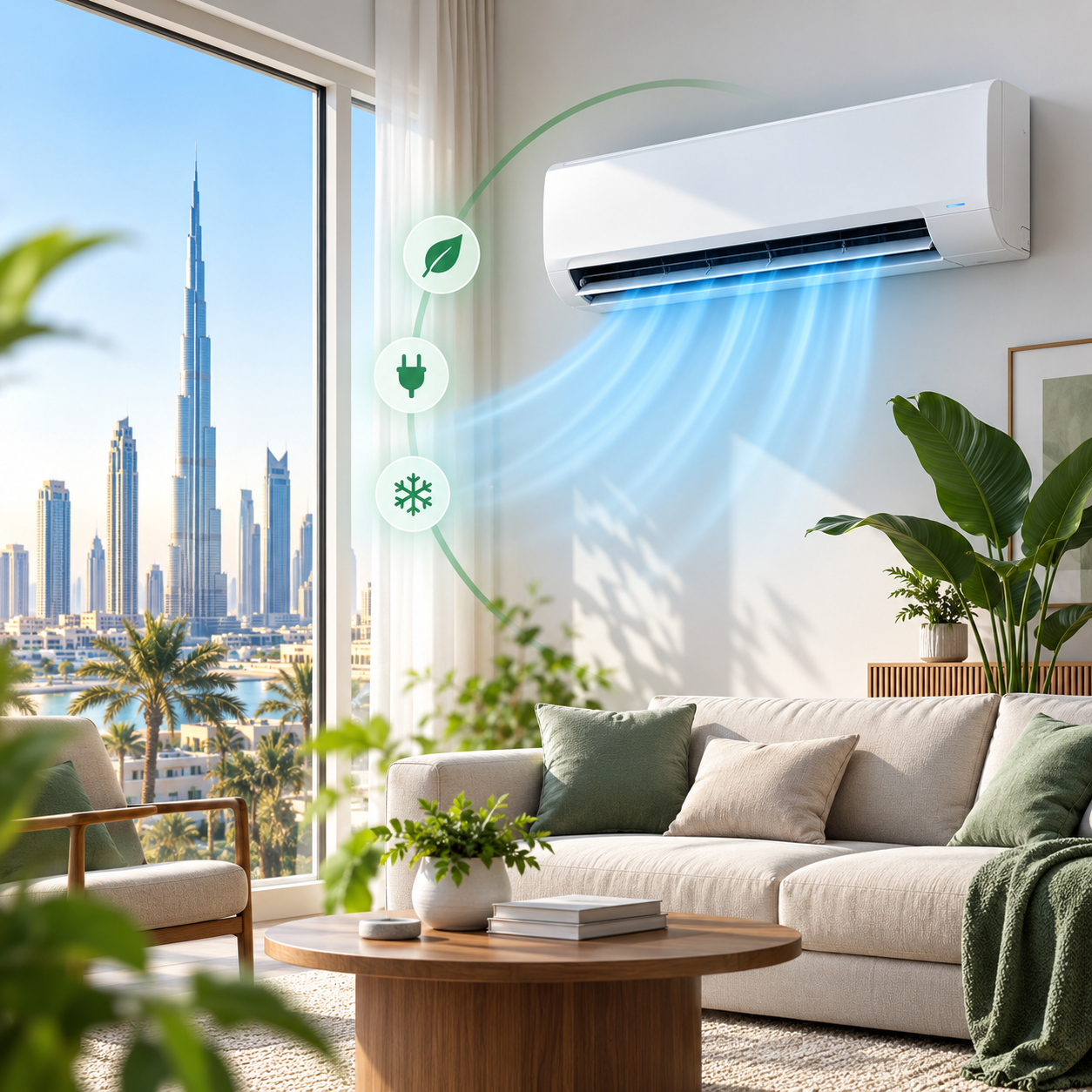
Best Split AC 2026: Comprehensive Guide to Energy-Efficient, Quiet T3 Inverter Air Conditioners
Selecting the optimal split air conditioner is one of the most critical long-term capital investments for any household or commercial establishment across the Arabian Gulf, Egypt, and the wider Middle East. During summer months, ambient shade temperatures routinely climb above 50 degrees Celsius, pushing thermal heat transfer through uninsulated building envelopes to extreme levels. Under these harsh thermodynamic conditions, conventional air conditioning units experience severe compressor tripping, rapid mechanical wear, and skyrocketing electric utility bills that can comprise up to 70% of total residential energy expenditure.
Modern HVAC engineering has evolved significantly beyond brute-force constant-speed compression. In 2026, thermodynamic performance standards are governed by strict energy efficiency mandates, including the Saudi Standards, Metrology and Quality Organization (SASO), the Saudi Energy Efficiency Center (SEEC), the Emirates Authority for Standardization and Metrology (ESMA), and Egyptian national energy standards. This comprehensive engineering evaluation investigates Tropical Climate Class T3 compressor thermodynamics, contrasts Dual Inverter rotary mechanics with fixed-speed systems, reviews acoustic indoor decibel ratings, and delivers the exact BTU room sizing formula. Furthermore, savvy homeowners can leverage verified promotional codes from Samsung, Noon, Homzmart, and 2B Electronics.
Engineering Criteria for Selecting an Air Conditioner Built for Extreme Desert Heat
To survive intense Middle Eastern summers while maintaining whisper-quiet operation and minimal electricity consumption, split air conditioners must satisfy four non-negotiable engineering benchmarks:
1. Tropical Climate Class T3 Compressor Certification
International HVAC manufacturing standards (ISO 5151) categorize climate operational envelopes into three tiers: Class T1 (moderate climates operating up to 43°C), Class T2 (cold climates), and Class T3 (extreme tropical/arid climates). A Class T3 certified compressor is engineered with heavy-duty thermal overload switches, oversized magnetic motor coils, and high-viscosity synthetic POE (polyolester) lubricants capable of continuous, uninterrupted heat exchange at outdoor ambient condenser temperatures up to 55°C and survival bursts up to 60°C. Standard T1 air conditioners trip repeatedly under direct sun exposure in July and August, leading to premature motor winding burnout.
2. Dual Inverter Rotary Compressor Mechanics
Traditional fixed-speed compressors operate on a crude binary principle: the motor runs at 100% capacity until the room thermostat reaches the setpoint, shuts down completely, and restarts with a massive electrical surge when the temperature rises by 1.5°C. In contrast, Dual Inverter compressors employ two twin rotary compression cylinders offset by 180 degrees, modulated by variable-frequency micro-controllers. By modulating motor rotational speed smoothly between 10 Hz and 120 Hz, inverter systems maintain room temperature within a tight 0.5°C tolerance while slashing monthly electrical power consumption by up to 53%.
3. Refrigerant Thermodynamics: R32 vs R410A
Next-generation 2026 split air conditioners increasingly transition from legacy R410A refrigerant to eco-efficient Difluoromethane (R32). R32 delivers a 12% higher volumetric cooling capacity, operates at lower thermodynamic system pressures, improves heat transfer coefficients by 5% to 8%, and possesses a Global Warming Potential (GWP) of 675—a dramatic 68% reduction compared to R410A's GWP of 2,088.
4. Condenser Anti-Corrosion Metallurgy: Gold Fin and Blue Fin
In coastal Gulf cities such as Dammam, Jeddah, Dubai, and Alexandria, airborne atmospheric salinity and humidity cause rapid galvanic oxidation of copper tubing and aluminum condenser fins. High-performance split units incorporate hydrophilic Gold Fin or Blue Fin polyurethane chemical coatings that resist salt-spray corrosion, extend condenser operational life beyond 12 years, and prevent thermal heat exchange efficiency drop-offs.
Comprehensive Comparison of the Top Split AC Brands in 2026
Our engineering testing panel evaluated the top five split air conditioning systems available in the Middle Eastern market, benchmarked across tropical cooling speed, energy efficiency ratios, indoor acoustic decibel levels, and warranty coverage:
1. Gree Polar & Boom: The Undisputed King of Extreme Desert Endurance
Manufactured by Gree Electric Appliances, the world's largest specialized residential air conditioning manufacturer, Gree Polar and Boom models represent the gold standard of mechanical reliability in Saudi Arabia and the Gulf. Engineered with two-stage compression technology and heavy-gauge galvanized steel outdoor housings, Gree units continue to produce ice-cold airflow even when outdoor ambient temperatures touch 58°C.
Equipped with a self-cleaning evaporator, four-way motorized air louvers, and a high-density antibacterial filtration grid, Gree is the premier choice for villas, top-floor apartments subjected to direct rooftop sun exposure, and desert compounds where reliability is paramount. Spare parts and qualified technician availability across the Middle East are universally accessible.
2. LG DualCool Inverter: Maximum Acoustic Silence and Power Economy
For master bedrooms, nurseries, and study rooms where acoustic silence is as important as cooling power, the LG DualCool Inverter is virtually unmatched. Generating an ultra-quiet indoor operational sound level of just 19 decibels—quieter than a human whisper in a library—LG achieves acoustic tranquility through skewed fan blades and brushless DC (BLDC) motor engineering.
LG's proprietary Dual Inverter compressor modulates speed continuously, eliminating temperature swings and reducing electricity consumption by up to 53% compared to non-inverter models. Integrated LG ThinQ smart Wi-Fi allows homeowners to monitor energy consumption in real time and initiate pre-cooling remotely from a smartphone before returning home. LG backs the compressor with a full 10-year manufacturer warranty.
3. Samsung WindFree: The Revolutionary Draft-Free Cooling Experience
Many consumers experience muscular stiffness, morning headaches, or dry throat when sleeping directly under the blast of cold air produced by conventional split units. Samsung solved this bio-ergonomic challenge through its patented WindFree technology. Once the setpoint is reached in rapid cooling mode, the front air louver closes, gently dispersing cool air through 23,000 microscopic perforations across the front panel.
The resulting airflow creates a "Still Air" micro-climate (defined by ASHRAE as airflow moving slower than 0.15 meters per second) that cools the room uniformly without direct draft. In WindFree mode, the Digital Inverter Boost compressor throttles down power consumption by up to 77%. You can order authentic Samsung WindFree air conditioners directly through Samsung UAE or via Noon with code PLT160.
4. Carrier XPower Gold: Industrial Reliability for Expansive Living Spaces
Willis Carrier invented modern electrical air conditioning in 1902, and that engineering heritage continues with the Carrier XPower Gold series. Carrier split systems are celebrated for their exceptionally robust airflow volume, propelled by heavy-duty squirrel-cage cross-flow fans capable of projecting air up to 12 meters across expansive reception halls and traditional open-concept majlis living rooms.
The unit features Gold Fin anti-corrosive condenser plating, automated refrigerant leak detection sensors, and a multi-stage active carbon deodorizing filter that removes smoke, kitchen cooking vapors, and airborne dust particles common during desert windstorms.
5. Mando Plus & Zamil Classic: Practical Value and Economical Maintenance
For rental properties, guest rooms, home offices, or budget-conscious homeowners, local and regional value brands like Mando Plus and Saudi-manufactured Zamil Classic deliver exceptional value per tonnage. Utilizing proven rotary compressor architectures and high-efficiency copper tubing, these units withstand intense seasonal heat cycles while offering the lowest initial acquisition cost and the most economical replacement parts in the market.
The Precise Formula for Sizing Air Conditioner Tonnage to Room Dimensions
One of the costliest errors made by homeowners is purchasing an improperly sized air conditioning unit. An undersized unit runs constantly at maximum capacity without ever achieving the thermostat setpoint, overheating compressor coils and tripling electric bills. Conversely, an oversized unit cools the room so rapidly that it satisfies the temperature sensor before running long enough to dehumidify the air, leaving the room cold, clammy, and prone to indoor mold development.
The Middle Eastern HVAC Sizing Formula
Due to high thermal radiation and ceiling heights, HVAC engineers in the Middle East employ a specialized volumetric thermal constant (300 BTU per cubic meter for standard rooms, or 350 BTU per cubic meter for uninsulated top-floor rooms subjected to direct solar rooftop heat):
Required BTU = Room Length (m) × Room Width (m) × Ceiling Height (m) × 300
To convert British Thermal Units (BTU) to nominal AC Tonnage (Ton of Refrigeration), divide the resulting BTU figure by 12,000 (since 1 Ton of Refrigeration = 12,000 BTU/h = 3.517 kW of thermal cooling):
- 1.0 Ton (12,000 BTU): Suitable for small bedrooms, home offices, and kitchenettes measuring up to 12 to 14 square meters (with standard 2.8m ceiling heights).
- 1.5 Ton (18,000 BTU): The most popular residential capacity; ideal for master bedrooms, medium dining areas, and living spaces measuring 15 to 22 square meters.
- 2.0 Ton (24,000 BTU): Recommended for large master suites, family living rooms, and open kitchens measuring 24 to 32 square meters.
- 2.5 to 3.0 Ton (30,000 to 36,000 BTU): Engineered for spacious open-concept majlis rooms, duplex reception areas, and commercial exhibition spaces measuring 35 to 50 square meters.
How to Read the Energy Efficiency Card and Cut Utility Bills by Up to 53%
Regulatory energy labels—such as the SASO Energy Efficiency Card in Saudi Arabia or ESMA Star Rating in the UAE—provide clear comparative metrics based on the Seasonal Energy Efficiency Ratio (SEER). SEER measures the total cooling output in BTU provided over an entire simulated cooling season divided by the total electrical energy consumed in watt-hours.
A modern Class A Inverter split AC achieves a SEER rating exceeding 17.0, compared to an older fixed-speed Class F unit operating at a SEER of less than 10.5. Upgrading three residential split air conditioners from an older fixed-speed setup to Class A Inverter models yields average utility bill savings of 2,400 to 4,200 Saudi Riyals annually across peak summer cooling cycles.
Where to Buy Authentic Split Air Conditioners with Installation Warranty and Wafarna Promo Codes
Ensure that your split air conditioner is purchased through authorized distributors offering official manufacturer warranties and certified technician installation:
- Samsung (كود خصم سامسونج): Shop the official store deals on WindFree T3 Inverter split systems with home delivery and warranty coverage.
- Noon (كود خصم نون): Apply voucher code PLT160 or BEE13 for competitive deals on Gree, LG, Mando, and Carrier air conditioners with installation packages.
- Homzmart (كود خصم هومزمارت): Redeem promo code HM42 for seasonal discounts on home appliances, air treatment units, and modern room furniture.
- 2B Electronics (كود خصم تو بي): Use code DD63 for authorized carrier, sharp, and fresh air conditioners across Egypt with zero-interest financing plans.
Frequently Asked Questions About Choosing and Maintaining Split Air Conditioners
What is the ideal thermostat setting for balancing thermal comfort and power bills?
HVAC engineers universally recommend setting the indoor thermostat to 24 degrees Celsius (75°F). For every single degree Celsius the thermostat is lowered below 24°C, compressor power consumption increases exponentially by 6% to 8%. Setting the unit to 18°C does not cool the room any faster; it simply forces the compressor to run continuously at peak power draw without cycling off.
How frequently should split AC filters and coils be cleaned?
Wash the lightweight plastic mesh dust filters in your indoor unit under running tap water every two to three weeks during peak summer months. Clogged filters restrict indoor airflow, lowering evaporator temperatures until the coils freeze over into a solid block of ice. Furthermore, schedule a professional technician chemical wash for outdoor condenser fins once annually prior to the start of summer to clear desert sand and dust buildup.
Why does my split air conditioner leak water indoors?
Indoor water leakage is almost invariably caused by a blocked condensate drain line. As the cold evaporator coil removes humidity from warm room air, moisture condenses into a collection pan and drains outside via a gravity hose. Algae, airborne dust, and bacterial slime frequently clog this narrow line over time, causing the drain pan to overflow down the interior wall. Clearing the drain line with compressed air or a diluted vinegar flush resolves the issue immediately.
Share this article